Showing posts with label Exchange Rate. Show all posts

Tuesday, 12 April 2016

Inflation Will Rise More Than Expectation

The competitiveness of the country’s export is determined by the trade weighted critical real effective exchange rate in the international market. The real effective rate exchange rate may even depreciate when the nominal exchange rate is falling down. The best example is that of an appreciation of Pak Rupee in terms of US dollars from 100 to 105.
Hence we can say, the competitiveness of a country’s trade may take worst situation even when the nominal value of the country’s currency is lost.
The data of State Bank of Pakistan shows that since 2010, country’s trade weighted nominal exchange rate (NEER) has depreciated by 7%. During the same period of time, Real Effective Exchange Rate (REER) has appreciated by 23% till January 2016. Over the last two years the appreciation in REER has been much more noticeable. This is the time period that coincides with the continuous decline country’s exports.

Exports of Pakistan have dropped in terms of dollar by 14.4% during the first half of the fiscal year 2016. The result is further worsening of balance of trade by 4.3%. 
There have been numerous reason behind such structural reasons. Energy crisis can be jotted down on top of the list that has adversely affected the export growth. The recent back fall has been faced due to the loss of competitiveness of the domestic prices in the international market.
Unfortunately very less attention has been paid to the dynamics of exchange rate as a source for poor performance of the exporting sector. The composition of the export basket and entire structure of the economy has made the overall REER more vulnerable.
At the same time, with appreciation in REER appreciation, the total import demand has been increased due to the relative decline in the import prices. The data of State Bank of Pakistan suggests that the imports of Pakistan have been sharply increased in terms of US dollars since fiscal year 2013.
The REER of Pakistan has appreciated between fiscal year 2014 to 2015 from 5.6% to 8.8%. This has put worst impact on competitiveness of the local products. With inflation rate set as target by State Bank of Pakistan below 6%, devaluation of the currency can be one of the solution to achieve set inflation target through demand and cost effect.


Sunday, 10 April 2016

Stock Market and Oil Prices Correlation: Why From 25% to 91%?

Oil and water do not mix together but stock prices and oil prices does!
Both, the oil prices and stock prices were declining with the correlation of about 91% when oil prices dropped down to $40 per barrel in December 2015. Leo Chen who is the quantitative analyst at Cumberland Advisers called this correlation a “black swan”. According to him this correlation between oil prices and stock prices is not usual.  
From past five years the correlation between S & P Index and the oil prices was negative 71.8%. This shows that the stock prices and oil prices move in opposite direction. If oil prices rise, the stock prices fall and vice versa. However, from past twenty years this correlation has not been more than 25% as compared to current 91%.

Now the question here is what is so few and far between now and then?
As we know that these days the oil prices have been declining from the last quarter of 2015 in the international market. However globally this drop is not being considered as a good news. But why?  Why this decrease in oil prices is not welcomed in the economy?
It’s quite complicated!
There are many reasons behind this and different analysts and investors hold different view point. Some believe that this drop in oil prices is bad news for the corporates as it would affect their profits in the long run due to less demand of oil. This also includes productive economies like China, where the growth productivity has gone slower. Another school of thought relates it to prevailing trend of dollar in the exchange rate markets.
In order to understand the phenomena behind the swift dropping of oil prices, you may visit my article Dropping Oil Prices: An Alarm for Saudi Arabia. To get more information on current trend of dollar in the exchange market, visit my article
We may believe that there are several other ingredients involved in this oil and stock curry which are adding flavors to confuse the whole recipe. We may also say that if the investors would take a flight from commodity markets due to prevailing uncertainty and high risk aversion then the volatility in the stock market may also be another reason for the stock market and the oil prices to move in same direction against the norm.

However, the good news is that recently the slight temporary boost in the oil prices also raised the sentiments on Wall Street and the Dow moved up sharply. The blue chip companies got up with 153 points. 

Friday, 8 April 2016

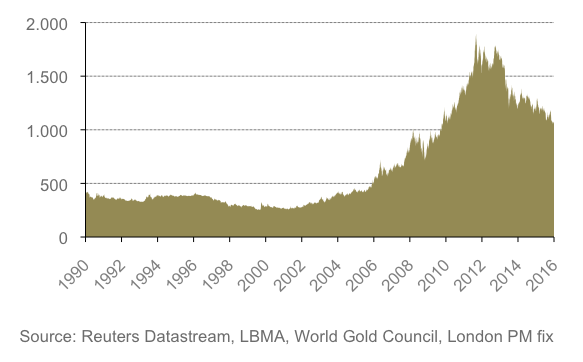
What Put Gold Market On Fire?

Gold price is on fire. It looks like something big has happened in the gold market. There was a magnificent change of trend in the gold prices from the mainstream during the first quarter of 2016. This shows that the investors are having insecurity about stock market and they are finding a way towards safe investment somewhere else… gold market may be…
Over the past several years gold market the gold market has been agonized by the decline in the outflow of gold from Gold ETF’s and Funds. This decline in the new outflows brought a drastic change in the international gold market in first quarter of the year.

According to Gold Demand Trends of World Gold Council the entire gold market suffered the net outflows from Gold ETF’s and such similar funds except for the small outflow of 25 metric ton that was built during first quarter of 2015. In the first quarter of 2016, this out flow was built up to 363 metric tons which is actually recorded to be the second highest build in the history of Gold ETF’s and Funds.
The first highest metal inventory was built at Global Gold ETF’s and Fund in first quarter of 2009. This was the time when stock markets were crashing down at their lowest levels. AT that time, the Global Gold ETF’s and Fund inventories rushed at 465 metric ton which was the highest ever.
There three important factors that act as driving force for bringing major change in gold markets are:
  1.  Net Sales and Purchases by Central Bank
  2.    Demand of gold coins and bars
  3.         Gold ETF’s and Fund Flows

When the Central Banks in West dumped 663 metric tons of gold in the market by the year 2005, the result was decline in the demand of total gold investment that reached 58 metric ton. This can be compared to the situation of gold investment demand of the year 2012 when it reached 2174 metric ton. This was an outrageous swing in the investment demand of gold with the difference of 2232 metric tons from 2005 to 2012. This catalyzed the prices of gold to hit as high as $ 1669 in Q1 of 2016.
In current situation, the investors need to realize that the popping up of wide Bonds and Stocks markets by Fed and other central banks won’t last forever. There might even be the possibility that Gold ETF’s and Fund Flows won’t even be having the gold that has been declared on records. The evidence of this is massive investments in paper gold. The investor only invests in the certificate and never gets to have gold in physical form. Most of the demand of gold investment is fulfilled this way. What investors really need to know is that if the flow of the mainstream investors would sign of things to come in future the things are really going to take new twists and turns by the year 2017.


Wednesday, 6 April 2016

Wall Street Once Again Wagering Upon Dollar: Will Dollar Rise or Fall?

Once again Wall Street is betting that the great dollar correction is going to begin. So is it true that dollar is actually in the middle of great correction? Or it is just that it’s a normal news trying to take hype in the exchange markets?

The trend of the market strategists, brokers and investors tend to be on the latter side of the wager. The reason behind this notion is driven by the fact that all the largest central banks of the world have simply given up on making efforts to make exchange rate to be correctly influenced by the monetary policy. This has happened due to large number of reasons that have its linkages from the past.
However, in this interim, the most recent uptick in the inflation rate of United States is engulfing the real interest rate differential which is the difference between the returns on the US dollar denominated assets and the prices of those assets in the foreign currency after inflation adjustment.
To make long story short, with the rise in the inflation, the returns on US denominated assets will decline as compared to their relative prices in the foreign currencies and the dollar would become less attractive for the local as well as foreign investors and dollar would be weaken even more.
The data reported by Futures Trading Commission this Friday shows that the aggregate of the total bets on the notion that dollar will appreciate has dwindled to its lowest level since the mid of July.
The head of the global currency strategy, Vasileios Gkionakis stated at UniCredit Bank that the central banks of the world are stepping back from their obsession of currency and that they are coming out of this massive overvaluation of dollar.
 According to Vasileios Gkionakis at first, the dollar appreciation wagering was fueled by the expectations of the investors that with the increase in the interest rates, the US dollar will go up as the relative interest rates of other countries would go down which will broaden the interest rate differential of US with the rest of the world. However, even these expectations swiftly got out of hands. In the first half of year 2015, the pair of Euro-Dollar bottomed out to as low as USD 1.50. This value was much lower to even justify than the expectations for the policy divergence.
After this entire scenario the investors are re-assessing the stance for their greenback currency. The head of the global currency expects the dollar to drift downwards in the upcoming years even in the condition when the US interest rates would boost up. This may be because the dollar has already been priced in standardization in monetary policy more than what the returns on treasury bills reflect it to be.
There is no coincidence. The weakening of dollar is happening just because of the pitfalls of the ultimate shifts in the way monetary policies are designed and conducted by the central banks for negative interest rate. Moreover there are further potential risks that are yet to be foreseen due to the negative rates of other countries. According to Bill Gross, one of the great bond investors, the negative rates would do nothing but put out downward pressure on the entire financial system.
However, Gkionakis has keenly noted that there is an additional risk attached to his perspective. There could be a rebound in US growth more rapidly than expected as a result of the ongoing trend. For this the gains and returns on the investment have to be strong enough to influence the investors to invest in the speedy fluctuations of interest rate.
There are still a large number of currency strategists and investors who are with the notion that dollar will strengthen by the end of the year. They believe that weakening of dollar would be short-term and temporary. The global strategists of Bank of America believe that they foresee Euro finishing the year with equivalent fate as dollar.

However, the recent uptick in US inflation and expectations regarding pickup in inflation would probably continue to weigh the dollar in the near future. According to Bank of America, the current trend of the policy divergence would again drive the US growth to outperform. They believe that soon the world would see investors rushing towards the dollar with euro equally competing in the market for the first time since 2002.